WoW Woman in the Future of Work - Maggie McDaris, CEO and Co-Founder of Phase
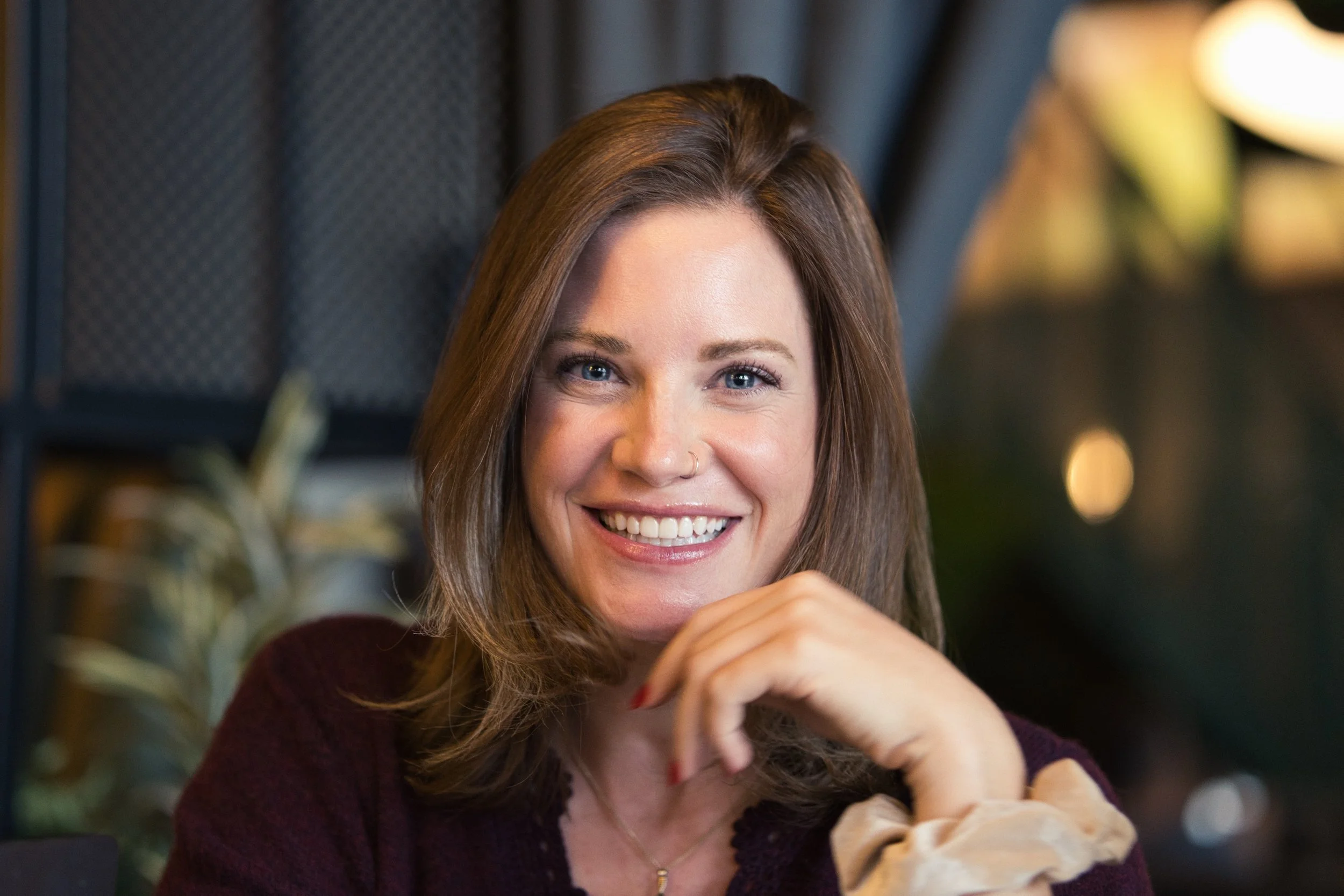
Maggie McDaris is the CEO and Co-Founder of Phase, a productivity software pioneering biology-driven productivity. Phase connects wearable data with calendars and task managers to help people plan work around their changing cognitive capacity and make productivity more sustainable and more human.
Maggie’s background spans public health, dietetics, corporate wellness, workplace strategy, and business building, giving her a deep understanding of the relationship between human performance and the way we work. Before founding Phase, she spent six years helping scale Lulafit from a three-person startup into a national business operating across 15 U.S. markets, with annual revenue growing from $300,000 to more than $13 million.
Since founding Phase, Maggie has taken the company from concept to validated product, launched its first beta, built an engaged audience and assembled a scientific advisory team spanning neuroendocrinology, sleep and circadian science, psychology and women’s health. Her work and Phase have been featured in the Financial Times, Stylist and Top Santé, and she has been recognised as a CRE Future Leader. She is passionate about the future of work, wearable technology and building tools that make biological data useful in everyday decision-making. Maggie lives in the UK with her family and dog Leo, and outside work enjoys horseback riding, football and spending time with her daughter.
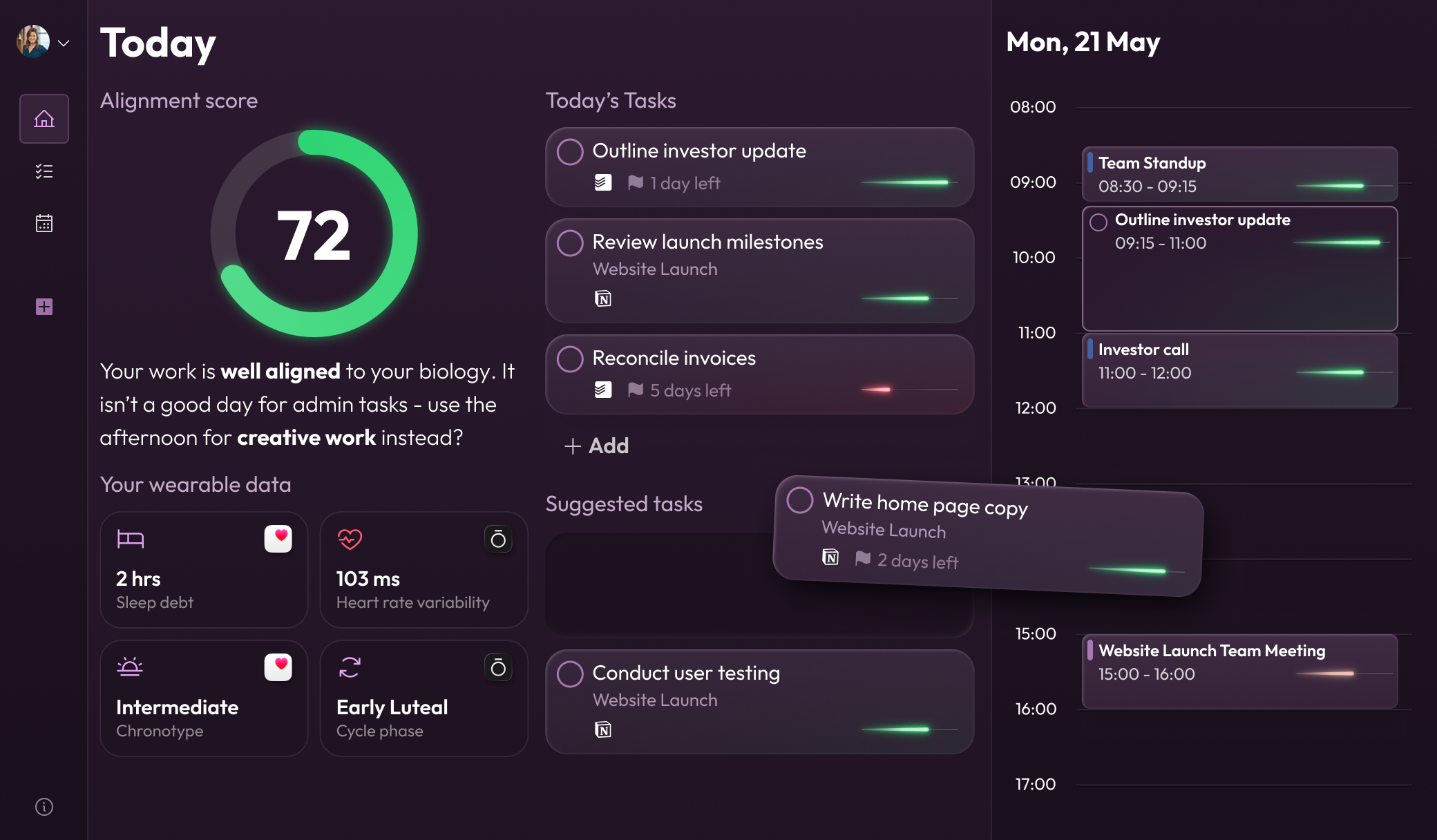
Phase is a productivity OS building for the future of human performance at work by pioneering biology-led productivity. We connect data from wearables and trackers - think sleep, HRV, recovery, cycle, and chronotype - with the calendars, task managers, and work tools people already use. We then translate those signals into a workday intelligently shaped around each person’s biology. Phase helps users prioritise tasks, time-block deep work, reschedule poorly aligned meetings, and do the right work at the right time. Our ambition is to become the category-defining platform between wearables and work: first for individuals, then teams, then businesses.
Tell us a bit about your background and your projects so far.
My journey to becoming a tech founder has been a winding one. I originally trained as a Registered Dietitian and started my career in public health, corporate wellness and workplace strategy. That eventually led me into building and scaling businesses and much of my career has involved taking ideas around health and wellbeing and finding ways to turn them into useful, revenue generating, and scalable businesses.
Before starting Phase, I spent six years helping build and scale Playbook, a high-growth commercial real estate startup. My time there is what taught me (often the hard way) everything I know about running a company: people, product, culture, operations, and all the beautifully messy bits in between.
I founded Phase after my own relationship with work broke down. After having my daughter, I went back to a very intense role far too quickly and eventually, I burned out quite spectacularly. Learning to understand my own biology and how it influences the skills and energy I have available became part of finding a more sustainable way to work.
With Phase, we’ve turned that concept into a bio-adaptive productivity platform that connects biodata from wearables (sleep, stress, HRV and hormones) with the tools people use to organise their work, helping knowledge workers optimise their work around their biology.
Human cognitive performance changes from day to day, and we think the technology around us should be able to understand and respond to that.
How did you get into this industry? Has it been an easy industry to get into or have you had many challenges?
I wouldn’t say the tech industry itself was especially hard to get into, and I’ve been overwhelmed by the amount of support and community we’ve had access to while building Phase. I’m not a technical founder, so I went and found two co-founder’s with a lot more experience building in this space than I had coming in.
One of the harder parts has been building something that doesn’t fit neatly into an existing category. When people already understand the category, you can focus on explaining why your product is better. When the category is new, you first have to explain the problem, why it matters and why the old way of doing things is no longer enough. There is a lot of education involved in that, and while most people understand that sleep, stress, hormones and recovery affect how they feel, they don’t necessarily connect that to how they plan their work. A big part of what we are doing is helping make that connection obvious and then immediately useful.
How long did it take you to be where you are now? What was the biggest obstacle? What are the challenges of being in the industry you are in?
Phase is only two years old, but it has already gone through several versions of itself.One of the biggest lessons our team has had to practice is the idea of staying deeply committed to a problem without becoming too attached to a particular solution.
The beta version of our product was focused on cycle syncing and was a much more education-forward and manual interpretation of a productivity tool. We launched it, got it into people’s hands, and learnt a huge amount about what worked, and more importantly, what didn’t.
Our beta data showed us that the problem was real, but the opportunity was much broader than the first product we had built, and our solution needed to better solve the problem if users were going to stick around.
One of our team values is the ability to “kill your darlings.” We have to be willing to let go of something we’ve spent time and resources creating if the evidence points somewhere better. For me, finding the right balance between conviction about the problem we’re solving and openness about how we go about solving it has been the biggest challenge.
What are your biggest achievements to date?
Without a doubt I'm most proud of the calibre of people who have chosen to build Phase alongside me.
Our founding team (shoutout Georgie and Sam) includes industry leaders who have already built and scaled significant technology companies. Additionally, we’ve been able to recruit an incredible clinical advisory council spanning neuroendocrinology, circadian science, psychology and women’s health who have kept us honest and rigorous in building a product led by pioneering biological alignment research.
I’ve been able to build a network of investors, scientists, operators and industry experts who could choose to spend their time on almost anything and yet have chosen to support me and Phase. Having really talented people understand the vision and decide they want to help build it means a lot to me.
I’m also proud that we were willing to change our minds. As mentioned above, we built something, got it into the market, listened to users and followed the evidence. That led us to a much bigger vision for the company in the end, but the decisions we had to make to get there challenged us.
What are the projects you are currently working on?
Right now, we’re focused on launching V2 of Phase, which is a much bigger expression of the original idea.
Phase connects the biodata people are already collecting from wearables and health apps with the tools they use to organise their work, like calendars and task managers. We take signals such as sleep, HRV, stress and cycle data, translate them into an understanding of cognitive capacity, and then look at what someone actually has to do that day. From there, Phase can help prioritise tasks, suggest better times for deep work, flag when a meeting or task is poorly aligned with your capacity, and help people plan their day around when they are likely to do different kinds of work best.
Is the #WomenInTech movement important to you and if yes, why?
Absolutely! I grew up watching my mum build an extraordinary career. She eventually became CIO of a Fortune 100 company in a very male-dominated industry, so I had a strong female role model very close to home.
I also saw how successful women were often expected to behave at work as though their biology did not exist. Periods, pregnancy, postpartum recovery and menopause have historically been things women were expected to manage quietly around their work. I have a daughter now, and I don’t want that to be her version of working life.
Women in technology matters because *who* builds technology affects what eventually gets built. Women’s biology has historically been poorly represented in research, data and product design, so when more women become founders, scientists, engineers, investors and product leaders, different problems get noticed and different assumptions get challenged. That leads to better technology for everyone.
What will be the key trends in your industry in the next five years and where do you see them heading?
We are all becoming increasingly aware that AI is changing the shape of work quite dramatically. However, I think we’re going to need to start paying attention to the impact that is having on human capital. As AI takes on execution-forward tasks (research, drafting, analysis) the things that are most valuable about humans (judgement, creativity, empathy, communication, intuition, leadership and original thought) become much more valuable. Those cognitive skills are governed by our biology and human cognitive capacity is a resource that’s going to have to be managed.
On the wearable side of things, so far a lot of wearable technology has focused on clinical applications, fitness and general wellness. I see a much bigger opportunity for that data to become useful in everyday life. I want wearable data to help me work better, parent better, be a better friend, and make better decisions about how I use my time and energy. That feels like a much bigger opportunity than simply collecting more data to bring to my next doctor's appointment.
Finally, privacy will become increasingly important. Biological data is deeply personal and people need to understand who can see it, what it is being used for and where the boundaries are, particularly when wearable technology starts to enter the workplace.
What is the most important piece of advice you could give to anyone who wants to start a career in this industry?
My first piece of advice is to surround yourself with people who are smarter than you. No founder has a complete skillset - we all have strengths and weaknesses. Be honest about yours and actively seek people who can not only make you better, but make what you’re building better.
Next, have an aggressive commitment to curiosity. Get close to the problem you want to solve. Talk to users and ask them honest questions. Build something, test it, then search out what works and what doesn’t. Be willing to find out that your first idea was wrong - and more specifically - WHAT about it was wrong so you can build better next time.
Who are three inspirational women in your respective industry you admire?
1) My co-founder, Georgie Powell. Phase simply wouldn’t exist without her. She’s spent much of her career thinking about how technology can make people’s lives better, from Google and YouTube to co-founding the digital wellbeing app SPACE. What I admire most is how she works. She is smart, endlessly curious, quick to expand her skill set to whatever the business needs, and works incredibly hard without losing sight of her own, mine or our team’s humanity. She is also a lovely HYROX partner.
2) Martha Silcott, founder of FabLittleBag. From the day we met, Martha has been both a mentor and a friend. She is incredibly generous with her time, her network and her connections. I also admire how she uses her business as a platform for things she cares about. She has spent years working to remove periods as a barrier to women and girls participating in sport, alongside building FabLittleBag. She has shown me that you can build a successful business and still give a huge amount of yourself to helping other people.
3) Melanie Perkins, co-founder and CEO of Canva. I so admire what she has built and the category she helped create. She saw a skill people needed access to and built a product that made it dramatically easier for millions of people. I love how close she stays to customers and how she learns from the way people actually use the product. But what I admire most is her belief that doing well and doing good can go hand in hand. I’m super inspired by how Melanie and her co-founder have committed the majority of their equity to doing good in the world.
Find out more about Phase on their website.