
200 Trailblazing Leaders in Women’s Health and FemTech
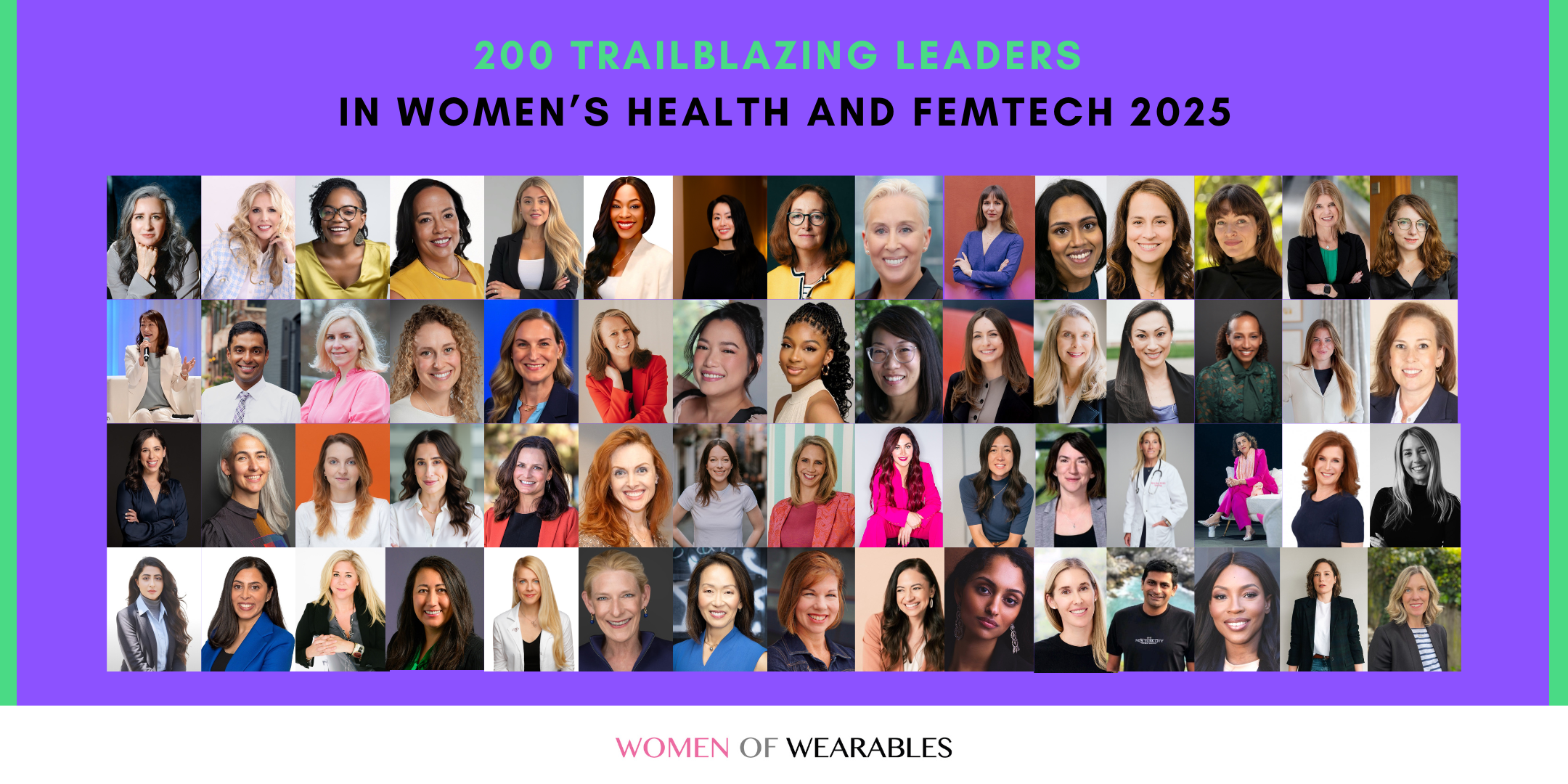
List compiled by Marija Butkovic and Anja Streicher
In 2025, the women’s health market advanced on multiple fronts, fueled by increased recognition of research gaps, strong funding pledges, and regulatory shifts. A record $2.5 billion commitment from the Bill & Melinda Gates Foundation over five years aimed at transforming women’s health R&D — particularly in underfunded areas like menstrual, gynecological, sexual, and maternal health — was among the year’s most significant funding news.
From a policy and clinical research perspective, 2025 saw meaningful progress in regulatory and scientific communities. The U.S. Department of Health and Human Services (HHS) and the FDA initiated the removal of long‑standing “black box” warnings from hormone replacement therapies (HRT) used in menopause care, promoting a more evidence‑based approach to treatment and potentially improving access and clinician confidence.
Despite this progress, 2025 also exposed ongoing challenges in the research ecosystem. In the US, federal funding cuts and concerns about the future of landmark studies — including uncertain funding trajectories for long‑running projects like the Women’s Health Initiative (WHI) — highlighted persistent vulnerabilities in public support for women’s health research. In response, nonprofit groups like Women’s Health Access Matters (WHAM) launched initiatives such as the 2025 WHAM Edge Awards, which provide critical support for early‑career researchers investigating sex‑based differences in disease outcomes and expand research capacity where traditional funding paths fall short.
Technological and scientific advances also made headlines: research into biomonitoring and sex‑specific physiological responses underscored how data science and large‑scale analysis can uncover previously obscured health transitions, such as the systemic physiological changes associated with menopause. Meanwhile, clinical practice discussions expanded into areas like PCOS treatment adaptations and the use of GLP‑1 drugs, reflecting shifting real‑world use patterns and a call for more dedicated research in hormone disorders.
Scientific Breakthroughs
In 2025, for the first time, scientists engineered mice that undergo full menstrual cycles — including endometrial breakdown and bleeding — enabling women’s health researchers to study menstruation in a controllable lab model. This overcomes a major barrier in reproductive biology since traditional lab animals do not naturally menstruate. Dr. Kara McKinley and her team at Harvard’s Department of Stem Cell and Regenerative Biology led this innovation. This new model opens doors to mechanistic studies of menstruation itself and conditions like endometriosis and heavy menstrual bleeding.
Another notable breakthrough was the development of ILETIA, an AI-enhanced method to predict the optimal interval between trigger injection and oocyte retrieval in IVF cycles. This individualized approach outperformed both clinician judgment and standard models for predicting oocyte maturity. A collaboration of Chinese reproductive biologists, including Binjian Wu, Qian Li, Zhe Kuang, Hongyuan Gao, and others (published on arXiv) contributed this prototype, building a predictive model using a dataset of nearly 10,000 patients.
When it comes to menstrual health, researchers identified novel molecular biomarkers and endotypes of unexplained infertility from menstrual blood serum extracellular vesicles, revealing potential diagnostic signals that could differentiate infertility subtypes. Led by K. Brennan, R. Vaiciuleviciute, I. Uzieliene, et al., this work was published in Scientific Reports in April 2025.
In the menopause space, a major data-science project analyzed ~300 million lab tests from more than a million women to dissect physiological changes across menopause, revealing step-like shifts in endocrine, bone, and metabolic systems at the time of the final menstrual period. Glen Pridham, Yoav Hayut, Noa Lavi-Shoseyov, Michal Neeman, Noa Hovav, Yoel Toledano, and Uri Alon published this in late 2025, applying deconvolution techniques to large cohort lab data. This work provides a quantitative physiology map of menopause, uncovering how hormone loss impacts multiple organ systems and offering benchmark data to guide treatment and hormone replacement strategies.
Funding & Investment
Pivotal — the philanthropy founded by Melinda French Gates — and nonprofit Lever for Change announced more than 80 organizations worldwide selected as awardees of the $250 million Action for Women’s Health global open call. This initiative was launched to fund community-driven organizations improving women’s mental and physical health across different regions and life stages, with each award ranging from $1 million to $5 million.
The UK charity Wellbeing of Women announced a £1.2 million investment in 18 pioneering women’s health research projects covering ovarian cancer diagnostics, blood clotting in endometriosis, menstrual and sexual health, pregnancy, fertility, and contraception research. Led by the Wellbeing of Women Research Advisory Committee, chaired by Professor Hilary Critchley, these awards launched in 2025.
NIH and other major global funding bodies (e.g., MIT’s Fairbairn Menstruation Science Fund) launched targeted funds to investigate uterine immunology, chronic disease risk, and menstruation biology, supporting long-term scientific progress. The Fairbairn fund ($10M) exemplifies this trend.
Funding commitments like these support the next generation of women’s health science and help fill historical research gaps.
Taken together, these developments illustrate that 2025 was a pivotal year in recalibrating how the market, policymakers, funders, and researchers approach women’s health — moving from fragmented, historically under‑resourced areas into a more coordinated, evidence‑rich, and multi‑stakeholder ecosystem with increasing momentum toward equity and impact.
List Criteria
In response and for the fourth year in a row, we set out to celebrate leaders and innovators shaping the present and future of women's health. We invited our community to nominate founders, scientists, researchers, innovators, and advocates—and were thrilled to receive more than 400 submissions in just over two months!
This year, more than ever, we received an overwhelming number of nominations for founders who have raised funds for their startups, which shows that the needle is slowly moving towards greater investment in this space. Finally!
The key criteria this year were focused on several areas, such as funding raised (>2mil.), major breakthroughs and milestones achieved for the company, key partnerships announcements, and other similar achievements that made the progress of the company notable in 2025, which means a great proportion of our list consists of founders, entrepreneurs and CEOs of women’s health companies.
We also tried to include as many people from key industry organisations that are flying the flag for the women’s health movement, ecosystem builders, key industry event organisers, notable investors, policymakers, and media professionals who are diligently covering femtech topics in their stories and columns.
Ultimately, our compilation of 200 Trailblazing Leaders in Women’s Health and FemTech aims to make the industry more accessible, inclusive, and ultimately visible, not just when it comes to the women’s health movement and innovation, but also the people who stand behind it.
Make sure to follow our channels below to be among the first to hear our news and updates, and to find out more about nominations for other categories and lists we plan to publish this year!
Become a WoW member here
Find out more about WoW on our website
Sign up for our newsletter to stay up to date with our activities
Join our LinkedIn femtech group where we discuss all things women’s health, femtech innovation, and investment
Reach out to our team at Women of Wearables at hello@womenofwearables.com to say hi, or find out how we could collaborate with you
FULL LIST
Disclaimer: The list has been arranged alphabetically and not in rank. We have also not included any medical titles in our list of participants, so it’s easier to navigate the list in alphabetical order by the name of the person. There are many more leaders who should be on this list and our aim is to include as many new names as possible every year. If you wish to suggest a correction or want to make a suggestion about someone who is not included in this year’s list, please drop us a line at hello@womenofwearables.com, and we will make sure to have them in mind for next year or add them to one of our other lists this year, such as the menopause and perimenopause list.
Check out our 2024 list, 2023 list and 2022 list
Aayush Rai and Varun AV, co-founders of Inito
Abby Mercado and Kristyn Hodgdon, co-founders of Rescripted
Alan Murray, founder and co-CEO at Conceivable Life Sciences
Adam de la Zerda, founder and CEO of Visby Medical
Adrianne Nickerson and Elaine Purcell, co-founders of Oula
Agata Zielinska and Oleksandr Yagensky, co-founders of Ovo Labs
Aimee Spector, Professor of Clinical Psychology of Ageing at UCL
Alex Taylor and Victoria Thain Gioia, co-founders of Perelel
Alice Zheng, Elizabeth Bailey, and Stasia Obremskey, co-founders of Foreground Capital
Ally Tam Tumasova, co-founder and CEO of Respin Health
Alyssa Dweck, Chief Medical Officer of Bonafide Health
Amanda Cupples and Sujitha Selvarajah, co-founders of Hesta Health
Amanda Ducach and Karishma Patel, co-founders of Ema
Amanda Shea, Fractional Chief Science Officer at Clue
Amy Gaston, VP of Strategic Growth at OhmBody
Anand Parikh, founder and CEO of Faeth Therapeutics
Andrea Ippolito, founder and CEO of SimpliFed
Angela Rastegar, CEO of Sunfish
Anish Sebastian, co-founder and CEO of Babyscripts
Anna Chif and Fiona Lake Waslander, co-founders of Coral
Anna Mason, Managing Partner at Ingeborg Investments
Anna O’Sullivan, founder of Future FemHealth and co-founder of the CensHERship campaign
Anoushka Menon and Andreas Hadjimitsis, co-founders of Genie Fertility
Antonella Chadha Santuccione, founder and CEO of Women’s Brain Foundation (WBF)
Areti Kalogerogianni, Managing partner and founder of WHIF (Women’s Health Impact Fund)
Ariella Heffernan-Marks, founder and CEO of Ovum
Ashley Abel and Kathy Potts, co-founders of Metri Bio
Ashleigh Niziol, co-founder and COO of Women’s Health Horizons (WHH)
Assia Grazioli-Venier, Founding Partner at Muse Capital
Bailey Renger, founder and CEO of BeSound
Beatrice Aretz, founder and CEO of Caona Health, co-founder of FemTech Germany
Belinda Tan, co-CEO of People Science
Bruno Van Tuykom, co-founder of Twentyeight Health
Carolee Lee, founder and CEO of Women's Health Access Matters
Carolyn M Mazure, Director and founder of Women's Health Research at Yale and Chair of the White House Initiative on Women's Health Research
Carolyn Quinlan and Jeremy Grushcow, co-founders of Juniper Genomics
Catherine Balsam-Schwaber, CEO of sōlaria biō
Charlotte Edenius, Gunilla Ekström and Patric Stenberg, co-founders of Gesynta Pharma
Charlotte Nørgaard Langer, founder of Nordic Women's Health Hub
Cherie Hoeger and Jonathan Hoeger, co-founders of Saalt
Chloe Ferro and Olivia Ferro, co-founders of SheMed
Christie Bloomquist, Vice President of Government Affairs and Policy at Astellas
Christopher Rand, CEO of AngelEye Health
Claire Tomkins, founder and Executive Chair at Future Family
Cindy Eckert, CEO and founder of Sprout Pharmaceuticals
Clara Stephenson, co-founder and CEO of Solence
Colette Courtion, founder and CEO of Joylux
Cristina Ljungberg, Gerda Mazi Larsson and Wendy Anderson, co-founders of The Case For Her
Currie Engel, News & Features Editor at Women’s Health
Daniel Lee and Paul Jin, co-founders of Lumia
Danielle Adewusi, founder and trustee at Scrub The Stigma
Danika Kelly, CEO of MyNormative
Dawn Androphy and Connor Gordon, co-founders of Allswell
Dawn Mattoon, CEO of Mercy BioAnalytics
Delphine Moulu, co-founder of Femtech France
Denise Pines, co-founder and CEO of FemAging Project and one of the co-authors of the documentary "The M Factor: Shredding the Silence on Menopause"
Dina Radenkovic, co-founder and CEO of Gameto
Edit Goldberg, CEO of Escala Medical
Elizabeth Burstein and Sameer Madan, co-founders of Neura Health
Elisabeth Staudinger, Managing Board Member at Siemens Healthineers
Ellen Rudolph, Claire Rudolph and Wallace Torres, co-founders of WellTheory
Elena Rueda and Paulina Cecula, co-founders of Dama Health
Elizabeth Zwillinger and Joseph Zwillinger, co-founders of Biologica
Emeline Hahn, CEO at Fizimed
Emilė Radytė and Alex Cook, co-founders of Samphire Neuroscience
Emily Greenberg, Alan Charming Chan and Charlie Carpenter, co-founders of Joy Parenting Club
Estelle Giraud and Ryan Nabat, co-founders of Trellis Health
Esther Hallam, founder and CEO of Nara Organics
Esther Krofah, Executive Vice President at Milken Institute
Evan Sussman, CEO of Granata Bio
Fiona H. Marshall, President, Biomedical Research at Novartis
George Makhoul, CEO of Dilon Technologies
Geri Stengel, contributor at Forbes Women
Giovanna Abramo and Lorena Ostos, co-founders of Plenna
Giulia Kennedy, co-founder and Chief Scientific Officer at PinkDx, Inc.
Hans Gangeskar, CEO of Overture Life
Helen O'Neill, Natalie Getreu and Deirdre O'Neill, co-founders of Hertility Health
Ida Grønborg, founder and CEO of Cacto Health
Irene Aninye, Chief Science Officer at the Society for Women's Health Research (SWHR)
Jackie Hanson and Suzanne Mason, co-founders of Sprout Family
Jackie Matthew, Chief Medical Officer at Fraiya
Jackie Rotman, founder and CEO of the Center for Intimacy Justice
Jan Witowski, founder and CEO of Ataraxis AI
Janet Choi, Chief Medical Officer at Progyny
Janet Lindsay, Chief Executive at Wellbeing of Women
Janine Austin Clayton, Associate Director of Research on Women's Health at the National Institutes of Health
Jaydeep Tank, Parikshit Tank and Bhaskar Shah, co-founders of Pluro Fertility
Jennifer Barsky, founder and Executive Director at Menoglobal
Jenny Button, founder and CEO of Emm
Jenny Lundkvist, Jennifer Grönqvist and Malin Frithiofsson, co-founders of Daya Ventures
Jessica de Mesa-Lim, founder and CEO of Kindred Health
Jessica (Schiffman) Gaulton, founder and CEO of FamilyWell Health
Jessica J. Federer, founder and managing partner of The Women’s Health Fund
Joanna Strober, co-founder and CEO of Midi Health
Joanna Bichsel, founder and CEO of Kasha Global
Joe Connolly and Shelly Lanning, co-founders of Visana Health
Jodi Neuhauser, co-founder of the Women’s Health PAC and founder of In Women’s Health
Jocelyn Wessels and Warren (Lauren) Foster, co-founders of Afynia Laboratories
Justyna Strzeszynska, founder and CEO of Joii Care
Kara Egan, CEO of Teal Health
Karli Büchling, founder and CEO of Blake Health
Karolina Löfqvist, founder and CEO of Hormona
Karyn Onyeneho, founder and CEO of Color of Genes, Senior Advisor for Genomic Data Sharing, Division of Neuroscience, National Institute on Aging (NIA), National Institutes of Health (NIH)
Kate Condliffe, CEO of Diana Health
Kate Ryder, founder and CEO of Maven
Kathrin Folkendt, founder and CEO of Femtech Insider
Kathryn Godburn Schubert, President and CEO, Society for Women's Health Research
Katie Baca-Motes, co-founder and CEO of GSD Health Research
Kathy Lee-Sepsick, President, CEO and founder at Femasys Inc.
Katy Whalen, co-founder of Joi + Blokes
Kay Koplovitz, co-founder and Chairman of the Board at Springboard Enterprises
Keara Sauber, CEO of Incora Health
Kimberly Langdon, founder and CEO of Coologics
Kristina Cahojova, founder and CEO of Lady Technologies
Lara Zibners Lohr and Thang Vo-Ta, co-founders of Calla Lily Clinical Care
Lauren Barker, CEO of Uresta
Lauren Makler, Halle Tecco and Arielle Spiegel, co-founders of Cofertility
Léa Wenger, founder and CEO of Cyclana Bio
Leah Sparks, founder and CEO of Wildflower Health
Linda Goler Blount, President at Black Women's Health Imperative
Linda Greub, Managing Partner at Avestria Ventures
Linda Griffith, Director at the Center for Gynepathology Research at MIT
Linda Sejdova and Thomas Zahradnik, co-founders of Snuggs
Lindsay Davis, founder of FemTech Association Asia
Liz Powell, founder of Women’s Health Advocates and co-founder of Breast Cancer Early Detection Coalition
Lynn Westphal, Chief Medical Officer at Kindbody
Maaike Steinebach and Sophie van Dijk, co-founders of Femtech NL
Maike Scharp, Deputy Director, Diagnostics and co-chair of Innovation Equity Forum at Bill & Melinda Gates Foundation
Maneesh Jain, co-founder and CEO of Mirvie
Maneesha Ghiya, founder and Managing Partner of FemHealth Ventures
Mandikudza Tembo, Menstrual health expert, Founder of The Bleed Read, Public Health Specialist, and Postdoctoral Fellow at Reckitt Global Hygiene Institute
Maria Molland, Executive in Residence at Frazier Healthcare Partners and women’s health investor
Mariana Schiffer Acar, Medical Lead Reproductive Health, Global Medical Affairs WHC at Bayer
Mario Aichlseder, CEO at Hello Inside
Marissa Fayer, CEO and founder of HERhealthEQ, CEO at DeepLook Medical
Marina Pavlovic Rivas and Thomas Cortina, co-founders of Eli Health
Marta Bralic Kerns, founder and CEO at Pomelo Care
Marta Ciechonska, co-founder of Salient Bio
Mary Claire Haver, founder of The 'Pause Life’ and Perimenopause and Menopausal Education expert
Maryann Umoren Selfe, founder and President of FemmeHealth Alliance
Maryon Stewart, CEO of Femmar
Maureen Quinn Salamon, Executive Editor of Harvard Women’s Health Watch
Maxime Kryvian, co-founder and CEO of Celsius Innovations
Maya Kale and Mili Kale, co-founders of Moom Health
Melinda French Gates, founder of Pivotal Ventures
Mia Chorney and Susan Sly, co-founders of The Pause Technologies Inc.
Michael Recht, Chief Medical and Science Officer (CMSO) of the National Bleeding Disorders Foundation (NBDF)
Mika Miyake, Business Development Manager, EMEA, at Garmin Health
Mindy Simon, co-Director at NHS Innovation Accelerator
Mitzi Krockover, CEO and Founder at Woman Centered and Managing Director at Golden Seeds
Nader AlSalim, founder and CEO of Gaia
Nathan Edwards, founder of the Women’s Health Week events series
Navneet Kaur, founder and CEO of FemTech India
Neha K Motwani, founder and CEO of Luma Fertility
Nick Aubin and Paulo da Costa, co-founders of Commons Clinic
Nigina Muntean, Chief of Innovation and Transformation at United Nations Population Fund (UNFPA)
Nikoletta Buczek, Deputy Head of Innovation and AI Center, Institute of Mother and Child, Warsaw
Nimmi Ramanujam, Director of the Center for Global Women's Health Technologies at Duke University and founder of Calla Health Foundation
Noel Pugh and Santosh Pandipati, co-founders of Lōvu Health
Olena Ivanova, Senior researcher, FemTech advisor, founder of Women’s Health and FemTech Ukraine, co-founder of FemTech Germany
Poppy Howard-Wall, Event Director for Women’s Health Innovation Summit at Kisaco Research
Pranay Jivrajka, founder of Allo Health
Professor Dame Lesley Regan, Women’s Health Ambassador for England
Rachel Bartholomew, founder and CEO of Hyivy
Rachel Blank, founder and CEO of Allara Health
Rachel Braun Scherl, co-host of Business of the V podcast, co-founder of 51&
Ravi Ramachandran and Abhishek Ramanathan, co-founders of Nua
Rebecca Hope, Director, Global Health at Emerson Collective
Rebekah E. Gee and Rebecca Kavoussi, co-founders of Nest Health
Regina Dugan, CEO of Wellcome Leap
Ricky Chiu, Chairman and CEO of PHASE Scientific
Roozbeh Ghaffari, CEO and co-founder of Epicore Biosystems
Sabrina (Martucci) Johnson, President and CEO at DARÉ Bioscience
Samantha Isola, Lesley Farrah Dorwling-Carter and Isabel Holguera Vera, co-founders of Femtech Portugal
Samira Daswani, founder and CEO of Manta Cares
Senan Ebrahim and Izzie Fulcher, co-founders of Delfina
Shruthi Mahalingaiah, M.D., M.S., physician-scientist, Assistant Professor of Environmental, Reproductive, and Women's Health at Harvard T.H. Chan School of Public Health
Simin Lee and Lauren McConnell, co-founders of Systole Health
Simone Theiss, Program Manager at EPFL Innovation Park and Tech4Eva Accelerator
Sioned Fôn Jones and Tara O'Driscoll, co-founders of BoobyBiome
Sophie Smith, founder and CEO of Nabta Health
Stasa Stankovic, co-founder of OvartiX and co-founder of WEALTH
Sukie Whitehall, Head of Women’s Health and Medical Device Designer at Cambridge Design Partnership
Rachel Bartholomew, founder and CEO at Hyivy Health
Susan Torroella, Chief Executive Officer of ProgenyHealth
Suzanne Gilberg, Chief Clinical Officer of Monarch MD, Author and founder of Menopause Bootcamp
Tammy Sun, founder and CEO at Carrot Fertility
Tamsen Fadal, NYT Bestselling Author of ‘How To Menopause’ and Producer of The [M] Factor Films
Tanja Brycker, Vice President at Hologic
Tanja Danner, CEO and co-founder of Prenaital
Theresa Neil, founder of Femovate
Tiffany (Davis) Inglis, Chief Medical Officer at Sera Prognostics
Tina Keshani and Sophia Richter, co-founders of Seven Starling
Tom Bourne, founder of Gynaia and Chair in Gynaecology at Imperial College London
Tomoko Minagawa, Executive Director, Women’s Health Commercial Lead at Organon, Founder of Femtech Community Japan
Torkia Mahloul, co-founder and CEO of Ovasave
Ula Rustamova and Irene Jia, co-founders of Level Zero Health
Valerie Kirchberger, Eva-Maria Meijnen and Cornelius Remschmidt, co-founders of Evela Health
Virginia Pensabene, CEO of IVFmicro
Witney McKiernan, Principal at HealthQuest Capital